
Steve recently sat down with Brad Barron, General Counsel of Conner, Strong & Buckelew, a leading insurance brokerage. They discuss the ups and downs of the insurance industry, exploring topics such as commercial insurance, health insurance pools, client retention strategies, and the impact of emerging technologies like AI. Brad shares his unique perspective and discusses his own journey from private law practice to his current role.
Steve: I have the pleasure today of being with Brad Barron, the newly minted general counsel of Conner Strong and Buckelew, an insurance brokerage headquartered in New Jersey. Welcome, Brad.
Brad: Thanks, Steve. Great to be here with you today.
Steve: Let’s start out with getting a lowdown on Conner Strong. Give me the vital statistics. Tell me what the company is like, what it does best, what you like best about being there.
Brad: Sure, we’re close to 600 employees across our different entities. We are a commercial insurance brokerage. So we focus on mid to large-size companies. And one of the other things that we do is we run the largest non state-sponsored health insurance pool and joint insurance pool in the United States. In New Jersey on the commercial side, we have what are referred to as the CEL and the MEL – the County Excess Liability program and the Municipal Excess Liability program – where there’s a ton of different governmental entities that are part of those. And on the health insurance side, we have a number of different what are called HIF’s – health insurance funds – that help dramatically decrease the cost of health insurance for different municipalities and governmental entities.
Steve: Wow, I didn’t know any of this.
Brad: Yeah, around 600 employees. I think the last number I saw was 585, so we’re getting close and we have a number of offices. We’re in New York City, Boston, Toms River, Dover, Delaware, and then our headquarters is Camden, New Jersey. We actually are, next month, opening a decent sized office just right near you in King of Prussia.
Steve: That’s great. So how many times have you been interviewed?
Brad: This is probably the first one, Steve!
Steve: Well, I will tell you, it’s the first time I’ve conducted an interview. I think we’re going to be okay.
Brad: Okay, fire away.
Steve: What originally attracted you to Conner Strong?
Brad: I’ll go back and talk a little bit about my time with you and the team when I was at Drinker with you and the rest of the life insurance and annuities practice group. One of the things that I really enjoyed, and I thought that fit me very well, was the white glove touch, very high service level, very entrepreneurial approach to business and our clients. You had always talked about how there were no inherited clients. They were all clients that people at that group had obtained at some point and kept them through hard work and relationships and all those things that are the hallmark of a very high touch, white glove type of service level. That’s what I was looking for. I really enjoyed that aspect of it. I always thought of myself as someone who provided really good service, or at least tried to, and that’s one of the things that Conner Strong really prides itself on is that same level of high touch white glove. We refer to ourselves as concierges of risk, if you will. Just by way of example: in terms of the level of service that Conner Strong provides, some of the larger brokerages who are similar in volume as we are, will have a couple of claims consultants, maybe somewhere around three to five. We have 35, so that’s the level of investment from the company and the desire to provide our clients with outstanding service, so everything is done to the client’s satisfaction. That really spoke to me, and it felt very similar to the way we operated when we were at Drinker.
Steve: It’s interesting you use that comparison, because one of the things that people outside the insurance industry knock brokers for is that they overly emphasize the production of the placement, and don’t give the back-end service nearly the same level of attention. And I’m not surprised to find that you would have liked a company who was doing that.
Brad: One of the things that we found is we have very high client retention in an industry that has a lot of client turnover. We’re consistently in the 97, 98, 99% of client retention. And I remember a couple years ago, we did a net promoter score analysis, where your clients give you a score of one of three things: they’re okay, I would recommend them, or I wouldn’t recommend them. And I think the industry average was somewhere around 46 or 50%. We came back at 92%. So we’ve really found that our business model works really well for the clients that we have and the clients we hope to get.
Steve: Do you have several industries in which you’re particularly well known?
Brad: I would say construction and real estate are probably our two larger ones. We also have a large healthcare and human services practice, but really we serve across all industries. We have a very large construction practice, in part because some of our folks are sort of pioneers for a type of insurance program called a contractor or owner-controlled insurance program. So you’ll see those on very large construction projects, like new skyscrapers, large upgrades to campuses, those sorts of things. And there’s a great way for clients to hold down costs and control costs on a very large project, where otherwise you might have some concerns about runaway costs or coverage issues with subcontractors and general contractors.
Steve: But you came to Conner Strong not on the production side. You came there as a lawyer. What was the transition like from a private law firm to corporate America?
Brad: I think in some ways, it was very similar, like we talked about earlier, being able to transition into a culture. The cultural fit was very comfortable, so that made it easy. Obviously, I think I had been trained well at Drinker and at law school.
Steve: How many lawyers were at Conner Strong when you joined?
Brad: When I joined, it was myself and the General Counsel, Heather Steinmiller. I was the first number two lawyer, if you will. Now our legal team is six people. We have three lawyers, and we’ll soon have a fourth.
Steve: And my instincts tell me that when you come in as the second of a two-person law department, you do a lot besides legal work, don’t you?
Brad: Yes, and when I was at Drinker, one of the things that we had always talked about was to have a broader breadth. And I really enjoyed my time with the law firm, but I really found that as a real positive when I moved to Conner Strong, because there were only two of us, we really were involved in a ton of stuff, not necessarily legal, like you said. I remember I was involved as part of a software implementation, not really a legal issue per se, but more of an operational issue, helping to put together client updates, putting on seminars, all those things that aren’t necessarily technically legal in nature. Those were things that I think helped to, number one, round out my skills and, two, help me understand the business better, because you’re involved in a broader breadth of things, but also help just keep you intellectually curious and learning new things all the time. I really found it very rewarding.
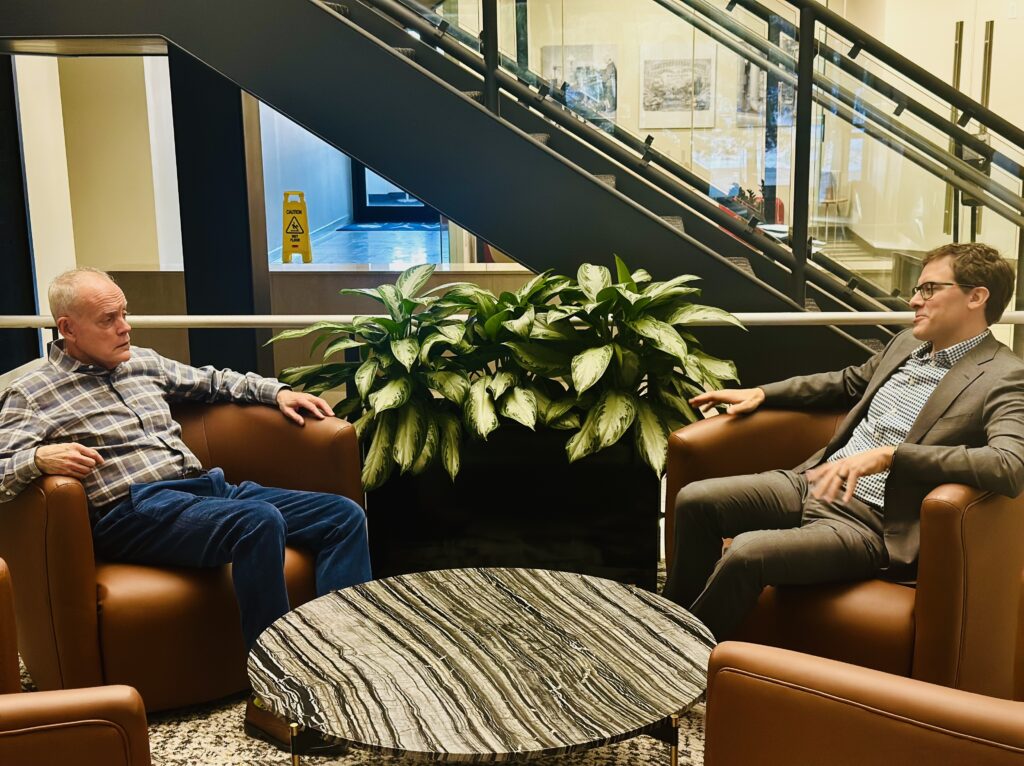
Steve Baker and Brad Barron
Steve: Let’s go back a little bit in time. You went to BC undergrad and studied Biology, correct?
Brad: I concentrated, because I found it so interesting, in ecosystems. It’s quite interesting figuring out how all the animals and plants work together. But by the end of my junior year, I came to the realization there probably wasn’t as much of a market for that level of skill as I hoped there might be. And at the time, my then girlfriend, who’s now my wife, was gung-ho and had always been gung-ho about law school. And so I thought, well, that sounds interesting, let’s put off reality for a couple more years. I’ll try law school. You know, I like to argue!
Steve: You and Nicole met at Boston College, correct? And I guess you must have decided that you were both going to come to Philly because you were connected here.
Brad: We both wound up getting into Villanova law school. We didn’t apply to all the same places, and it worked out that we both went to Villanova. And like most law schools, you tend to get a job in the general geographic area of the law school. That’s just the way it works. It’s easy, right? That’s where the recruiting and the recruiting companies and law firms are from and I’ve been here ever since.
Steve: And what did you do for your first job out of law school?
Brad: My first job out of law school was working for a very small reinsurance practice out of Exton, Pennsylvania. There were four lawyers, and I was number four. I think at one point we were up to five, and they did international reinsurance collections from all sorts of these old reinsurance pools. They did some work for Equitas, which was the Lloyds asbestos runoff, and then a bunch of stuff out of South America. And it was very interesting. They allowed me to travel to interesting places like Monaco, Cologne, and London. I did that for three years, but after that, I really wanted to go and see if I could make my way in a big law firm.
Steve: And wasn’t Nicole either a former or present colleague of Sean Brogan?
Brad: Sean had recently left Drinker for the Graham Company, and he heard through the grapevine that I was looking, so I got in touch with him and he’s been a friend and a mentor ever since. He said, “Look, you should really think about Drinker Biddle. I have nothing but good things to say.” And at the time, your group was hiring. And also, Heath. I went to law school with Heath. Who was already there in the practice group. And it all worked out!
Steve: It sure did. And how many years then were you with us?
Brad: I was with you for nine years.
Steve: These days, do you have direct interface with Conner Strong clients in your capacity as general counsel or wearing another hat?
Brad: I do have direct interface with our clients on a couple different levels. On the general counsel level, I work with our clients all the time on just our fee agreements with them as well as any issues or questions they have about the company.
I also interface with our clients in more of an advocacy role. If there is a difficult claim where our claims team needs some additional assistance, my team and or myself will help them get that across the goal line. In addition, I also am directly responsible as a “claim consultant” for a few clients. And just generally helping out wherever I can. There are all sorts of questions that clients may have that may not necessarily be an insurance question, but we try to guide them to the right resources and help them reduce their risk.
Steve: However you can, without saying anything about confidential information that you shouldn’t reveal, can you tell me about one of the more personally satisfying achievements you had in advocating for a client?
Brad: I’ll go back to Drinker first, because I know you’ll enjoy this one. It was towards the end of my time with you there, but we had been dealing with a very long and contentious case involving some contentious folks. And all along, we had thought that our client had been wrongly sued, that they really did everything right. There were no issues with how they had handled the insurance policies, et cetera. And as part of a very large discovery bomb that was dropped on us by the other side, one of our teammates was able to sift through and find a very damning email where, essentially, the other side had admitted that more or less everything that they had alleged our client did wrong was all a lie, and so helping to bring that to conclusion and being able to end that in a positive note. I think one of the interesting things was that you were obviously heavily involved in that, and the client really wanted to make sure that they were vindicated, and they wound up actually being paid by the plaintiff as part of the settlement, even though our client was the defendant. I thought that was just the coolest thing that all that hard work and effort paid off in the end. And I think the client felt really positive about how that ended.
Steve: I remember it well. And I remember being myself, being really, almost, dumbstruck when a client leader said, tell these people now that if they don’t dismiss this case, I will not settle it thereafter, unless they pay me. And I thought, okay, fine, but I never thought he would stick to it. And he did!
Brad: I thought that was really interesting and cool. And then on the Conner Strong side, I think one of the big challenges a lot of our clients face is just the never-ending cyber attacks. There’s a lot of wire fraud these days, but if you go back five or six years or seven years, the big issue was ransomware. So essentially, a business is shut down. You can’t operate. And early on, I became heavily involved across the board with all of our clients with cyber issues, and helping them walk through that process, helping them obtain the resources that are needed, by way of their insurance carriers and otherwise, so they can get back up and running quickly. I really feel like we make a very positive difference, because some of these people don’t know if they’re ever going to be operational again. Is their business going to still exist in a week, right? And so that’s been very satisfying.
Steve: So it’s potentially a life and death difference for the business. Wow.
So this is your first job since law school that has a significant non-legal component. Is that fair to say?
Brad: I think that’s a fair comment. I like the mixture and I think that it keeps everything fresh and more interesting. Being able to be more involved in the business side and have some input and impact there is satisfying. And also, you feel like you really do provide good guidance and advice to clients, whether or not they take it as a different question, because obviously the business leaders are dealing with a lot of different balls to all keep in the air and balance different issues, whether it’s personnel, budget goals, but having an impact there and trying to help the business grow however we can. It’s really rewarding. It’s not just sitting away redlining a contract all day, right? Which is obviously still important, it’s still the core job.
Steve: Ten years ago in 2015, would you have thought you would be where you are today?
Brad: That’s a tough question! I think I’d always hoped to be here but of course you never know. General counsel positions are not always available. There’s not a ton of them. I think that one of the things that I look back on is I remember something that you and Mike Miller talked about, which was when people would look at certain very successful partners, or people who are really good in their field, they always say, oh, that person just got lucky, right? Oh, they got that client because it was luck. And one of the things that you and Mike always emphasized is to the outside world, it looks like luck. What they don’t see are all of the time toiling, trying to make yourself better, trying to develop those relationships, putting yourself in a position all the times you fail, right? Because for every great client you get, there’s probably 5, 6, 7, 8, that you chase, that you don’t get. And so it’s, all the hard work that people don’t see. I think one of the things when I look back at 10 years ago is you have to put yourself in a position to be able to be considered for a job like that – hard work, understanding the business, being dedicated to the team. And people may have a view of it being lucky, but I feel like I’ve worked really hard. I’ve also been very, very blessed with great mentors who’ve also been managers. You being one of them. I don’t know that there’s a lot of people, especially in the legal field, who take the time as a manager to also be a mentor. And when I think about it, it’s a hard line to know when are you a mentor and when are you a manager? Right? Because a manager has to sometimes throw the gauntlet down and be very direct, and a mentor has to cajole and help bring out the best. And I always thought that that was something that had to be really hard for you to balance, but you did really well.
Steve: Well, you’re very nice to say that. To me, it’s always been a matter of an investment, and like every portfolio of investments, some investments pay off more than others. But if you go in, if you make an investment based upon what seemed to be the right qualities, you have got to keep investing right?
Brad: When I went to Conner Strong, my boss, Heather Steinmiller, she was very much in the same mold as you. I got really lucky in that regard, that I had very long relationships, you for nine years and Heather for eight, where I got to work for someone who was very knowledgeable, but also very willing to help push me, help me grow, help point out where I needed to grow, because I think sometimes a lot of people aren’t served well by some managers and mentors because they’re not given honest feedback. And even though it’s not always the most comfortable thing to tell someone where they’re falling short, they’re never going to know if you don’t tell them, and they’re never going to be able to help get over that hump, whatever it may be.
Steve: Absolutely right.
What’s your favorite food?
Brad: Now that’s a really, really tough one. I have to say I could tell you what my least favorite is. My wife will laugh at this. I cannot eat grapefruit.
Steve: Who doesn’t like grapefruit!?
Brad: I don’t know what it is. I think maybe as a very young kid, I thought that I was ordering grape juice, and instead I ordered grapefruit juice, and I was very surprised when it was sour, right? But as to my favorite food, I love Italian food. If there’s a good lasagna, I have a problem pushing that plate away.
Steve: What’s your favorite pro sports team?
Brad: I’d have to say the Chicago Cubs. I’m originally from Peoria, Illinois, and so grew up there for a few years. My parents moved back and forth between Pennsylvania and Illinois. My extended family is still in Illinois. So my dad brought me up right. A good Cubs fan.
Steve: How about college sports?
Brad: Obviously, a big Boston College fan, you always have to root for your alma mater. And then after that, I just really love college sports. I think that March Madness is incredible. The College Football Playoff is really fun. Bowl season of course.
Steve: How about Ohio State versus Notre Dame?
Brad: I think that’s a tougher call for you than it is for me, being a Michigan fan! I’m surprised you use their name rather than just call them the school down south.
Steve: So interesting times, right, to be in the insurance industry. And I wonder if it looks to you like it does to me, that the insurance industry just can’t catch a break in the mind of the American public?
Brad: Yeah, I think that’s right. They have a PR problem.
Steve: I’m troubled by the fact that this industry is essentially indispensable to business particularly, and yet it’s very vulnerable. We now have two examples of that within the last 90 days, that assassination in New York, and now what’s happening in California, right? What do you make of this?
Brad: I think that the insurance industry continues to be challenged by public relations issues. It’s very easy for an individual to feel aggrieved, and in some cases, he or she is probably right. Whether or not their kid has been cut off from an important medication or an insurer is not paying for a home that was damaged by something, and there’s some dispute, and that sort of thing is an ongoing issue that has been going on for some time. I will say one of the things that I think people should take heed of, and maybe, we all would do well for this, is if your insurance company doesn’t want to cover you for something or wants to have a very low sub-limit on a particular risk, you should really think long and hard about what that is, and are there other ways you can mitigate it. The insurance companies are risk companies in that their whole business is making sure they understand what the likelihood of some damage or issue is. And so, when you read about insurance companies wanting to pull back from fire coverage in Southern California, I think that was probably a signal that more people should have heeded that there are some significant increased issues going on around the likelihood of a fire, whether or not anything can be done about it.
Steve: Well, I think that’s a terrific point, because what people tend to forget is insurance companies would like to make the premium dollars.
Brad: That’s exactly right. And so, you look at what’s going on in California, the companies have been pulling out of the California market for some time, and now they’re pulling out of certain lines. So I think the California market in particular has some real challenges on the personal lines side. We’ll see what happens. I think that I wouldn’t be surprised if there is a tremendous shortfall between insurance proceeds and damages incurred in the aggregate there.
Steve: When I watch the pictures coming from California, I think of the Jersey shore, obviously a bit closer to home, and I think of the encroachment of sea level, right? Is that something that the industry is looking at?
Brad: Yes, we have a significant personal client group portfolio that handles a lot of high net worth individuals, and they’re seeing a lot of challenges on Long Island and the immediate New York City area. You can think of all the little inlets and beachfront areas there that they’re finding it very difficult to place property coverage or hard to get coverage in terms of what is necessary to protect that property. Someone may be willing to give you a million dollars, but the property to rebuild would cost 2 million dollars. They’re doing it in terms of being able to place the coverage, but they’re seeing that market get a lot harder, difficult to place, and the price is going up in part because of exactly what we’re talking about. I think Superstorm Sandy got a lot of insurers attention with how much of that area was inundated with at least a foot of sea water.
And I think the other thing that carriers are doing every day, and they’ve started a number of years ago, is they’re looking at how concentrated they are in certain areas. So if you look back at a picture of some shore towns 50 years ago, it’s far fewer homes or buildings. So you have much bigger properties, in some cases, high rises, and the houses that used to be bungalows are now mansions. So insurers are saying, well, I really don’t want to insure everyone on this street, because if there’s an issue, I’m going to pay out on 10 multi-million dollar homes and I really only want to insure every 10th home or so to make sure my portfolio is spread out. Then I’m not overly concentrated. I think as that’s happening, and they’re trying to be very careful to make sure they can pay the claims for their customers, you’re finding not as many other insurers willing to come in and fill those little gaps.
Steve: Do you guys have a research unit that looks at those kinds of issues independent of whatever placement or claim activity you might have?
Brad: We don’t have an in-house group, but we have a number of vendors that help provide those services to us and help our team try to stay at least abreast, if not one step ahead, of what’s going on out there.
Steve: Did you hear about the lawsuit criminal complaint that was filed by the Attorney General of Texas against Allstate and some of its affiliates for essentially coming into the possession of millions, maybe tens of millions, of pieces of data on the driving habits of Americans by piggybacking on apps that people use in their cars and information that the cars generate. Is that case familiar to you?
Brad: I’ve heard a little bit about it, but we’re on the commercial side, so we’re focusing more on larger businesses. And most of our private clients are on the coasts, if you will. We have some in Texas, but not many. So it hasn’t been something that’s impacted our customers too much, fortunately. But I think that’s an interesting issue. I think that again, it goes to the difficult balance that regulators have of regulating an industry, like you said, that’s so important, but also allowing them to try to quantify properly the risk out there, and at the same time balancing the privacy needs of customers, right? There are a lot of constituencies whose needs have to be taken into account.
Steve: This is a great example of the devil is always in the details, right? No matter what the Texas Attorney General may say in a pleading or a charging document, if the user agreements that apply to the apps that are collecting the data allow it to be transferred to third parties, that puts a whole new spin on things.
That brings up the question of just technology and AI in general, and how that’s affecting the insurance space. How do you see that affecting the industry going forward? Obviously there’s an efficiency side to it, but also a data collection aspect on the customer side that might come off as invasive. How do you see that playing out over the next 5, 10, years, as technology becomes more ingrained in everyday processes like underwriting and risk modeling?
Brad: I will say everyone in the insurance space, from carriers to brokers to wholesalers to customers, is trying to figure out the best way to use AI and what are the things that are the most efficient uses for it, right? We are heavily invested in that. We’re one of the founding members of an entity called Broker Tech Ventures – an incubator that we are part of with a number of other brokerages that focuses on broker specific technology. Every year, we have a number of entities that go in as part of the incubator, as the cohort, and some of them come out and are successful. In terms of where we’re using AI, we recently had a hire, about a year ago, of a data scientist that we hired away from a competitor who worked on the CERN laboratory in Switzerland. She’s extremely, extremely smart, and so we’re lucky enough to have her and focusing on all the things that AI can do on our side. Things like cyber, there’s no general form. These forms can be changed all the time. So even though it may say the same stuff, it could look very different. The traditional ways of comparing documents are very difficult. You can’t just run and compare a red line. In order to do it efficiently, you’ve got to train AI to be able to understand what it’s seeing and say, oh, page one is actually the new page five, or whatever the case may be.
I think on the underwriting side, there’s a lot of modeling that’s going on and one of the issues that we’re hearing a lot about is actually in Middle America in terms of the storms that are going on there. You think about like the Texas hail storms, freeze events, putting aside what’s going on in California right now, since we don’t know the numbers yet, like in the last couple years, that swath in the central part of the United States, that’s been a super, super active area of the United States that you don’t hear too much about because we’re on the East coast. So they tend to focus more on what’s happening here. The other thing that they’re doing a lot of is carriers are trying to understand and use AI. I can’t speak for them, but I think one of the things they’re trying to do is understand entire supply chains. So if I’m insuring a company down in Louisiana that is a petroleum producer, who are all of their entities that provide services to them or buy from them? And then who are all their entities? So you can better understand, okay, do I have a concentration of risk somewhere? Because even though I insure petroleum companies in all different areas, they’re actually all reliant upon one supplier in say, Indiana, and if that supplier has an issue, I’m going to have an issue as an insurer, because all of my clients, who are the petroleum companies scattered about now can’t operate for some reason.
So all sorts of really interesting uses. I still think we’re just scratching the surface of where it’s likely to be. In some ways hard to predict, at least for someone like me, because I’m not in it as deep as some others to say exactly where it’s going to go.
I will say, from my perspective, I really think that AI is going to allow our people to focus on the more client-centric things. It’ll allow our folks to instead of having to spend time doing things that may be monotonous, repetitive, but are still necessary, AI can handle that, and now we freed up half of their day to go do something that is a higher touch issue for the client, helping to make those relationships better. I’m hopeful that AI is going not to replace our people, but to enhance our people. And I think that’s the direction we as a company are going as well.
Steve: When I started doing legal work that related to the insurance industry back in the 1980s you could argue whether or not it wasn’t still true that the center of the insurance universe was in London. It strikes me that those days are decidedly gone. Do you agree with that?
Brad: I think in a lot of ways the London market is still super important for specialty risks. You’ll think about, oh, I’ve got this one-off issue, or I can’t have or I can’t find admitted markets for whatever my client is, so it’s a very important market in that regard. But you’re right when you look at some of these specialty lines that are becoming more ubiquitous. For instance, I go back to cyber since there’s been an explosion of carriers and wholesalers who are providing cyber coverage now, whereas I think if you went back 20 years, even where the cyber market had been around, it probably was suppressed. I think a lot of people see opportunity in a lot of spaces, and so you’re seeing a lot of money come in in all sorts of different areas of the insurance marketplace, really democratizing it.
Steve: What do you like best about what you do?
Brad: I like that I get to do all sorts of different things. Being in-house as a general counsel, we’re heavily embedded in the business, and that makes it so no day is the same as any other day. There’s always something new, always something different. I really like that. We have a high touch business model with our clients that affords a lot of opportunity to feel like you’re really helping make a difference. And I go back to when we were at Drinker, and that was one of the things that always attracted me about what we did there, was we were so high touch. I really felt like we made a difference with our clients. And that’s just been something that’s been important to me in terms of feeling like I’m fulfilled on a professional level.
Steve: I bet it’s true for you, like it was for me, every day I would come to the office and I would have planned for the day, knowing that most of what I had taken the time to write down I would not get to,
Brad: Definitely a fair point. Especially I think even more so in-house, I found that, you have so many people that are looking for guidance, assistance, an issue that’s popped up, I find that most of the work that I’ve planned to get done gets done after six o’clock at night, and my day is essentially putting out fires, and then I get to the work I was planning to do, like at night or on the weekend.
Steve: Well, they don’t call it a service occupation for nothing.
You did address this to some extent, but I wanted to hear; are there two or three moments in the early years of your career that you can look back on and you say, yeah, that was a pivotal moment. That’s when I realized I had to do X, or that was when I realized my strength lay somewhere else. I mean, do you look at your career and can you identify when some of those moments were?
Brad: I remember the first time that I thought like, oh, I think I’ve made it. And you’ll laugh at this… it was my very first day at Drinker, when I walked in, they took me to an office, and we’re in a high rise building, and I thought, okay, I’m here. I have a chance to really learn a lot and do a lot of really interesting stuff. I’ll say that the second time was the very first time I ever did a deposition at Drinker Biddle. And I thought this was really interesting and I’ve tried to emulate it, which was, you helped me prepare as it was for your client. And I was so surprised when you said, okay, now go and do it and come back and tell me how it goes.
Because you hear a lot of people where the partner tags along, and I really thought that your philosophy of giving everyone a chance and also understanding that, if the partner is there, the associate or the person who’s doing it for the first time, or even second time, is going to feel intimidated, and constantly be looking over the shoulder about whether they do okay. And a lot of lawyering, I think, and really, probably business in general, is just trying stuff and seeing what works. Obviously you’re thinking through what the best thing should be. But there’s nothing like just going out and giving it a try. And what I try to emphasize to myself and my team all the time is like, we’re not doctors. It’s very, very rare that what we do is going to cause a serious problem, and we can almost always fix something, but we’ll never learn to get better if we don’t try something new or try it on our own. And so that’s one of the things that I picked up from you very early on. It’s one of the things I was lucky enough that Heather, the former general counsel at Conner Strong, also was a big advocate of, which is just you just have to go out and do stuff.
Steve: You’re right. Let me tell you something I don’t think you know. One of the reasons I didn’t sit in on people doing their first depositions was because somebody did it to me, and I remember how awkward and frankly embarrassing it was. And the truth is you have got to get out and try it right. Your second one will be better than your first, your third will be better than your second, right? And as you say, if you forget to ask a particular question, the case isn’t going to ride on that.
Brad: Well, I think you make an interesting point on that point, which is part of mentoring and learning is learning all the good stuff that people did, but it’s also remembering the stuff that you weren’t super appreciative of, or that you saw other people do to other people.
Steve: I don’t know if you know this, but my first appearance in court was in municipal court in Philly, and my opponent was an unrepresented individual, and he beat me. And I walked back to the office. I was working at Stradley at the time, and as I walked back to the office, I was thinking they’re going to fire me. I just got beaten by an unrepresented plaintiff, right? And they laughed, because pretty much everybody got beaten up at one point or another on those kinds of cases. I had been sent there to learn.
If you knew you couldn’t fail if you left this profession, is there another profession or activity you’re dying to see whether you can do?
Brad: That’s a really tough question. I don’t know if you ever listen to Mike Rowe. He’s the Dirty Jobs guy. One of his big things is, a lot of people talk about do what you love. His message is;
“You should do what you’re actually good at, because you can love doing (fill in the blank), but be really bad at it, and it’s just not going to change.”
I could love being an artist but it’s just not where my strengths lie. I will never create a piece of art that someone will want to buy. But I think that I’m a big history fan like you, and I think it’d be really cool to be a history tour guide. I’ve always thought that could maybe be my retirement job. Because even just in Philadelphia, I think there’s all sorts of little hidden gems. I don’t think there’s a lot of people that know there’s an eternal flame in Philadelphia.
Steve: That’s right, in Washington Square?
Brad: Yes, Washington Square. There’s also the Tomb of the Unknown Revolutionary War soldier … you talk to people who live in the area, and they’ve never even heard of it. There’s all sorts of little cool stuff in Philadelphia that would be really interesting to help open people’s eyes to and teach them about the history of America and just history in general.
Steve: Yeah, that is interesting. So, what do your kids think you do when you go to work?
Brad: I think they think that I sit in an office and bang away on a keyboard all day and talk about boring things. But no, they ask questions about insurance and contracts. Maybe they’re doing it to be nice. I can’t say that I’m confident they’re all that intrigued by it, and that they’ll ever consider following in my footsteps or my wife’s footsteps, but at least they put up with me.
Steve: I remember somebody telling me, when my daughter was in maybe third or fourth grade, there was a sort of go around the classroom and the teacher would ask the kids, what does your father or mother do at work? And Sarah said he argues with people on the phone. It’s accurate, right?
Brad: It’s certainly part of the gig!
Steve: What haven’t we gotten to that you’d like to talk about?
Brad: I think we touched on it a little bit earlier. But I think the importance of mentorship and feedback is crucial. No matter what field you’re in, I found it crucial for my growth and where I’m at today, and I really try as best I can to pass that along to the people that I work with, whether or not they directly report to me or not. And I also think the importance of having a really strong team. I’m lucky that I’ve got a great team. And they’re all really dedicated to their job. They’re very good at what they do, and it makes life so much easier.
Steve: A team doesn’t just happen. You have to build it.
Brad: Yes, and you’ve got to try to find the right people. And sometimes you don’t. You have to try and find what makes them tick, and make sure you keep them happy and doing what they’re interested in. And, sometimes that’s hard to do, right, because maybe what they’re interested in is something that you just can’t offer at the moment.
But, I think that that’s a new part of the role for me. Going from Deputy General Counsel, where I had one person or two people reporting to me, where now the whole team reports to me. It’s a matter of degrees, but it’s even more important – the management of my team and really making sure that they’re happy, because without them, the job becomes almost impossible.
Steve: Oh, I want to ask you one other question, can you cook?
Brad: I try. I try. No. So it’s funny you ask that because I’m one of the cooking merit badge counselors for my sons’ Boy Scout troop. But I do try to cook on the weekends. My schedule doesn’t allow me to get home too early during the week, so my wife handles the burden during the week, but I try to handle the burden on the weekends.
Steve: What are your top three best dishes?
Brad: So I think that if my kids had the choice, I make a really good slightly modified version of what’s called King Ranch Mac and Cheese. It’s probably a doctor’s nightmare, because there’s so much cream and cheese and stuff in it.
Steve: But that’s what makes it good!
Brad: I think I also do a really good baby back ribs. And I do a really good pot roast and veggies in a crock pot, get that all going. I like things that are relatively easy but also very filling.
Steve: Have you ever made grilled peanut butter and jelly?
Brad: I can’t say that I have, only because I don’t want to pretend when you are the master of such a delicacy.
Steve: It was completely by accident. But it’s a kid favorite, right? Especially for a weekend. I used to do it for sleepovers for Sarah and her friends.
Brad: Well, one other thing I think that’s probably relevant, really quick, is talking about knowledge and expertise. When people come to us, whether it’s you or me, they’re looking for someone who can help guide them on a difficult question, or provide clarity, at least on how to think of something. So maybe I’ll turn it around and ask you.
Brad: What do you think the most difficult part of your job is, and how do you make it easy for your clients in terms of explaining difficult concepts?
Steve: Well, I’m going to start by answering something that is a little different than what you asked. I think the hardest part of this job is explaining to people how the outcome isn’t going to be what they want. And I say that because I like to like my clients, and I identify with them. And you have those moments where you have to say, look, this isn’t going to work, and you can continue to pay money to fight it, but shouldn’t we try to make it go away, right?
Brad: Again, back to those honest and tough conversations, right? It may not be what they want to hear, but it’s what they need to hear.
Steve: Yeah, and, I mean, I think one of the critical roles of a lawyer, actually, it’s the critical role, is to be a counselor.
Advocate is fine. Anybody with the talent of persuasion, can go in and make the argument, but I think it’s a far more important skill to be able to create a sufficient level of trust between you and a client, that you can persuade the client that it would be better for him or her to do whatever it is you’re suggesting. I used to tell when law students would ask me, when I was in a law firm, what do you like about your job? One of the answers I used to give to that question was: I like it when my phone rings and I can tell from the voice on the other end of the line that the caller is glad I’m there. I think one of the things that has to happen is the client has to come to believe that you believe in them. So it’s not as if you wouldn’t make the argument, but that you put their interest so much in first place that they’re going to tell them if you’re not going to win, right?
Brad: Those are tough conversations. Because some people are really invested and you have to try to get them to understand that not all the cards are favorable to them.
Steve: And it can be very subtle, because you have to be able to say it in a way that doesn’t appear to be CYA, right. That you’re still their advocate. You can fight if you want, but we’re facing a tough climb. Those are miserable assignments.
Thank you, Brad, for being here.
Brad: Well, thanks, Steve, it was great.
© 2026 Stephen C. Baker LLC|Sitemap|Disclaimer
